
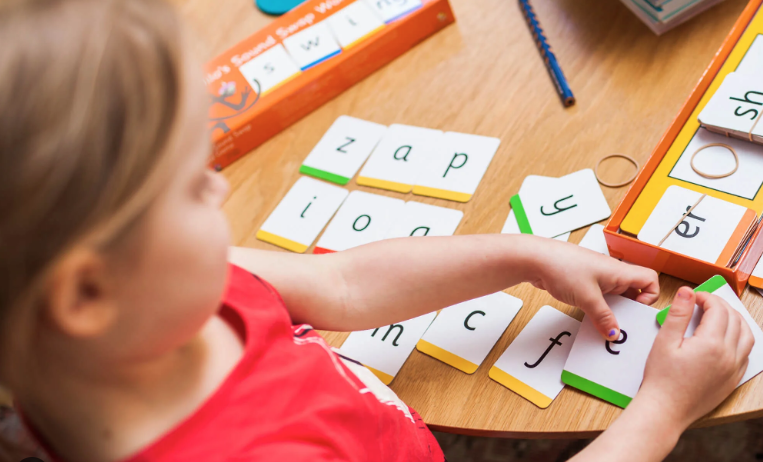
Being able to read and spell is not something that comes naturally. Children require explicit teaching to learn how to develop the skills to decode (read) and encode (spell) words.
There are four fundamental skills that underpin the ability to read and spell. They are…
Phonological (sound) awareness
Letter-sound knowledge
Phonological (sound) memory
Rapid automatic naming (RAN)
Phonological awareness is an umbrella term however at its core it means to have an awareness and understanding of how words are made up of individual sounds. Some examples of PA skills include …
Identifying first and last sounds e.g., dog starts with /d/ and ends with /g/
Identifying and producing rhyming words e.g., knowing sat and cat rhyme and thinking of an extra word that rhymes with sat and cat i.e., mat
Counting syllables in words e.g., the word hel-i-cop-ter has 4 syllables
Phonological awareness is a teachable skill and therefore, with support can be improved.
Letter sound knowledge refers to a child’s ability to connect letters with their corresponding sounds (i.e., the letter m makes the sound “mmm”). Strong letter-sound knowledge is required for decoding (reading) and encoding (spelling). This is another teachable skill.
Phonological working memory refers to a child’s ability to process, hold and repeat information (i.e., a series of numbers). A child with a strong phonological memory span can hold a series of sounds in their short-term memory, helping them to “sound out” unfamiliar words. This skill cannot be taught and needs to be accommodated for if it is an area of difficulty.
Rapid automatic naming refers to a child’s ability to recall the name of something quickly and accurately (i.e., colours). Strong rapid automatic naming skills support a child’s ability to read fluently. This is another hardwired skill that cannot be taught but can be accommodated with strategies.
Some children require additional support to develop their literacy skills. Speech Pathologists are trained to support literacy difficulties and can provide assessment, intervention and recommendations to support a child that is struggling with their reading and spelling. It is important to access early intervention for literacy difficulties as this is known to lead to better long-term outcomes for children in terms of developing their reading fluency. Reading fluency acts as a bridge, allowing readers to move past sounding out individual words and focus instead on comprehending what they’ve read.
If you have concerns about your child's reading or spelling skills, speak to a Speech Pathologist.
References:
Dehaene, S. (2019) Reading in the Brain: The New Science on How We Read. Penguin; 1st edition, 22 January 2019
Ehri, L. (2014). Orthographic Mapping in the Acquisition of Sight Word Reading, Spelling Memory, and Vocabulary Learning. Scientific Studies of Reading
Monaghan, R (2023)., The role of RAN in reading. READ3 blogpost. Accessed through: The role of RAN in reading – Read3 Literacy
READ3 (2021). What is Phonological Awareness. READ3 blogpost. Accessed through: What is Phonological Awareness – Read3 Literacy